
Bad reviews won’t cost you, when you learn a life lesson.
- Jasmine Duwe
- Apr 14
- 5 min read

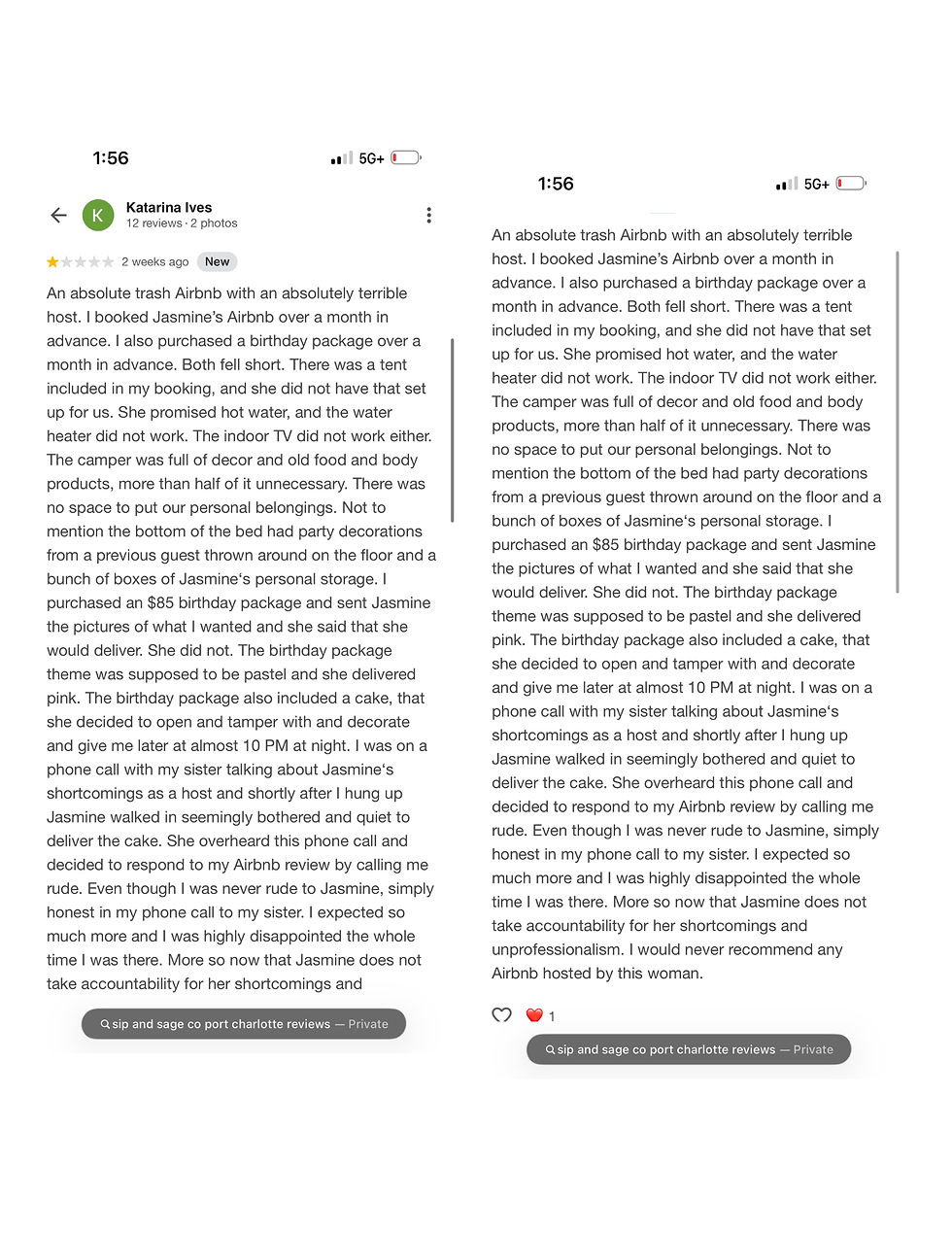
I got a one-star review that started with "This place is trash."
My first thought? Nobody's going to take this seriously. The opening line was so over-the-top that readers would dismiss it as emotional venting.
The review itself didn't define my business. My response did.
The Guest Who Paid $100 and Expected $300 Worth of Service
This guest booked my glamping property, Sip & Sage Co, for $100 per night during my launch period with a 20% discount. Most guests pay over $200. She added an $85 birthday package that included two huge bouquets, a store brought cake with Amazon decorations , balloons, and a birthday sign.
The Pinterest inspiration she sent me? Easily a $200 setup. I made it happen anyway because that's who I am.
Then her propane ran out mid-cooking. She didn't know how to swap the tank. I walked over, swapped it out, brought the birthday cake, and left. No thank you. No apology for the aggressive messages she'd sent when I didn't respond within an hour.
She was rude. I said so in my review of her as a guest.
That's when she went to Google and upgraded her three-star review to one star.
I Shared the Review Publicly and Laid Out the Facts
Here's what I did that most business owners won't do: I shared her one-star review and responded with complete transparency.
I explained the $85 birthday package that cost me more than double to execute. I mentioned she used three propane tanks and over 200 hours of water without additional charges. I wished her well and apologized it wasn’t a right fit.
The response from readers? "What is she complaining about?"
People didn't even need to see my response first. They read her review, looked at what she paid versus what she received, and immediately questioned her credibility.
But here's what the data shows: 97% of people who read reviews also pay attention to how the business responds. And 88% of buyers pick a business that responds to all its reviews, while just 47% would pick one that doesn't reply at all.
Your response matters more than the rating.
The Service Recovery Paradox Proved Itself
Something interesting happens when you handle a problem transparently. Research calls it the Service Recovery Paradox: customers are often more loyal after a service failure when the recovery is swift and good than customers who never experienced a problem at all.
That's exactly what happened with my one-star review.
People saw how I handled the situation and trusted me more, not less. They saw someone willing to admit imperfection, own the facts, and still stand behind the value delivered.
My brand, Sip & Sage Co, is built on "perfectly imperfected stays." Nothing I do is perfect. I might as well own it.
Transparency Without Accountability Is Hollow
I've learned this lesson repeatedly, not just with guest reviews but with corporate experiences too.
I left Moffitt Cancer Center after a Director told me to stick my dad in a nursing home when I asked for an additional 10-minute break to care for him 7 days before he passed. I sent a graceful resignation letter. They ignored me for over a week. When they finally responded, there was no apology, no acknowledgment of the situation, just a black-and-white defense of their policies.
That's the problem with most companies. They're transparent about policies but never take accountability for how those policies harm people.
Research backs this up: transparency alone doesn't increase accountability. "Untargeted" transparency without a clear recipient and following action actually reduces accountability.
When I posted my resignation letter publicly, it got over 100,000 views on Facebook. People responded because I wasn't just being transparent—I was holding the organization accountable for defending bad behavior instead of fixing it.
What I Learned About Handling Negative Reviews
I follow a lot of Airbnb host groups. When hosts get a bad review, even three stars, they respond emotionally. They act defensive. They attack the guest.
That's the wrong move.
Here's what I do instead: I read the review, sleep on it, and wake up the next morning asking myself if anything in the review is justified. What was the situation? Did I contribute to the problem?
We are not perfect. Nobody expects you to be God.
You don't need five stars across the board. You need to take accountability.
Only about 5% of businesses respond to their reviews, despite 89% of consumers expecting a response. That massive gap is your competitive advantage. When you respond transparently, you're already ahead of 95% of your competition.
The Real Lesson: Your Reaction Is What You Control
I can't control what happens to me. I've learned that hard over the last two years. I've lost income, totaled two cars, been screwed over by “a business” who cost me over $60,000, and have to pull two listings because of their lack of transparency.
What I can control is my reaction.
When someone comes to me with an issue, I'm transparent. I let them know the problem and ask what we can do to fix it together. If they take accountability, we move forward. If they ignore me or defend bad behavior, I go public.. I go legal.
Not to bash them. Not to destroy them. To hold them accountable.
Because that's fair. And because other people deserve to know what they're getting into.
Purpose Over Profit
My whole brand is built on this philosophy: purpose over profit.
That guest who left the one-star review? She paid $200 total for two nights and an $85 birthday package. I dipped into her nightly rate to make the birthday special. I lost money on her stay.
But I don't regret it.
Because my brand isn't about maximizing every dollar. It's about creating intentional experiences and being transparent when things don't go perfectly.
People follow that. They trust it. They book because of it.
And when I respond to a one-star review by laying out the facts without defensiveness or anger, they see someone who stands behind their values even when it's uncomfortable.
That's the reputation that follows you everywhere.
What This Means for You
If you're afraid of negative reviews, you're focused on the wrong thing.
The review itself doesn't define you. Your response does.
Sleep on it. Look at the situation honestly. Ask yourself if you contributed to the problem. Then respond with transparency and accountability.
Don't defend bad behavior. Don't ignore criticism. Don't respond emotionally.
Own it. Fix it. Move forward.
Because the people reading that review aren't just looking at the rating. They're looking at how you handle being called out.


Comments